20 years of Alto. How has scientific marketing changed?
20th June 2022 - Last modified 27th June 2024
We’re 20 years young this month! 2002 also saw some (other) developments that have had fundamental effects on scientific marketing…
By David Robinson, MD.

Summarising the changes in scientific marketing over the last 20 years seemed a great idea for a blog…but it’s not an easy task!
Almost everything has changed, and although many of the changes have been iterative, over two decades the changes are immense. I’m not going to cover everything in a short, hopefully easy-to-read blog, but I have focused below on some of the key changes, which in no particular order of importance include:
The rise and rise of the online presence
Having said “in no particular order”, thanks to a global digital revolution, it made sense to start with websites and online presence. Already very important back in 2002, ensuring that you have a good website in 2022 is not just important – it’s essential.
So much has changed in web design and user experience – much less clutter, mobile/tablet friendly, clear calls to action, e-commerce etc etc – and it’s the nature of the internet that everything will continue to develop. A site that’s only a few years old can begin to look dated and long in the tooth.
Of course, most developments are being driven by Google, which over the last 20+ years has risen to – and maintained – its position as the search engine of choice. It still has an 85% plus global market share [1], so all scientific marketers need to pay attention to any changes made to its algorithms.
And what about how researchers or healthcare practitioners find your site?
There are four main ways:
• Typing in your URL (Direct)
• Entering a relevant word into a search engine (Organic)
• Clicking on an email/banner/online ad (Campaign)
• From another site that has a link to yours (Referral)
Back in 2002, Google was in its infancy, and it was likely that most traffic arrived at your site either directly, by typing your URL, by clicking on a banner ad, or through an email link.
Fast-forward to the present, and after direct traffic, organic search is now the largest source of traffic to websites at just over 17%. This is closely followed by social media and email marketing at 16% and 14%, respectively [2].
Search engine optimisation (SEO)
When it comes to internet searches (let’s call it Googling!), people now just need to type in what they are looking for, and – depending on the efficacy of your SEO – your site should appear. A very effective way of making sure you’re always in front of the right audience.
However, remember keyword stuffing and unfettered link-building? So noughties! Fast forward to 2022 and those tactics would have disastrous consequences for your website. The genuine ways of enhancing a company’s appearance in the search engine results pages are now highly complex and continuously evolving.
Today, SEO is quite rightly all about search intent, including whether the user is looking for a product/service versus educational and other types of content. We’ll be talking about this more in an upcoming blog or you can check out our earlier blogs, such as this one.
Social media
2002 was also the year in which LinkedIn was established, in co-founder Reid Hoffman’s living room (something we’ve probably all been doing more of over the last 2 years!), although it was officially launched in 2003.
This was closely followed by the other main social media sites: Facebook (2004); YouTube and Reddit (2005); Twitter (2006); Instagram and Pinterest (2010) [3]. So, 20 years ago, social media as a marketing channel, just didn’t exist! Hard to imagine now.
In scientific marketing, LinkedIn, YouTube, Twitter (and to a degree Facebook) are currently the most relevant of the general/consumer social media platforms, however specialist scientific social networks such as ResearchGate are really well-liked by scientists and offer well targeted promotional opportunities.
In consumer marketing, social media influencers are important for many types of products, and with LinkedIn especially, there is even the emergence of social media influencers in scientific marketing.
Advertising and media
Print advertising – traditionally the staple of the trade media – has been blown away, first by online advertising options and then by the behemoth of search engine marketing (SEM). Pay-per-click (PPC) advertising was around 20 years ago, but has increasingly become the advertising model in scientific marketing, and coincidentally, 2002 was the year that saw Google move from what was a standard cost per (thousand) impressions model, to the PPC model [4].
As well as helping to improve return on investment through PPC, SEM also offers speed (you can get an ad online in a few minutes and repeatedly tweak it to optimise its performance), and targeting (serve your ad to users who are actively searching for your product/solution).
Linked to this sea-change in the importance of different channels has been the explosion in advertising options. Back in 2002, digital advertising was still in its infancy, so the biggest decision for scientific advertisers was still whether to go for a run-of-page double page spread (DPS) or the outside back cover (OK there were many other page sizes/placements, tip-ons, inserts…but you get the idea). Now the options for getting your message out to your target audience are almost limitless, as this recent blog from Shopify about Google ad types, shows [5].
The traditional print publications were slow to catch on to the change to online. Almost exclusively in 2002 their online offerings were extremely basic and didn’t take advantage of the potential marketing opportunities that the online environment offered. This left the door open for the trailblazer portals such as SelectScience, Technology Networks, GenomeWeb, Biocompare and Labiotech to become major players, which offer excellent promotional offerings.
Over the years, the established media have caught up and now have extremely good online marketing options, however a few have gone by the wayside. Remember International/American Biotechnology Laboratory, Laboratory Update, Medical Laboratory World? However, print is not dead, and whilst we have said goodbye to many magazines, a number of new ones have started such as The Medicine Maker, The Pathologist, Drug Discovery World, Drug Discovery News etc)
And then there’s the whole concept of contextual advertising – an impossibility in print media. It did exist 20 years ago, but it was extremely basic; pay your £/$/€* for a keyword(s), and your banner would appear whenever someone typed in that keyword into the publication’s search function. Contextual advertising is now the basis of Google Ads/SEM, and the advertising opportunities offered by most scientific content publishers is now based on serving promotional messages to audiences according to the context of what they are looking for/at.
* INTERESTING FACT: The Euro was also launched on 1st January 2002. Another major global change in the year that Alto Marketing was launched. Coincidence??!
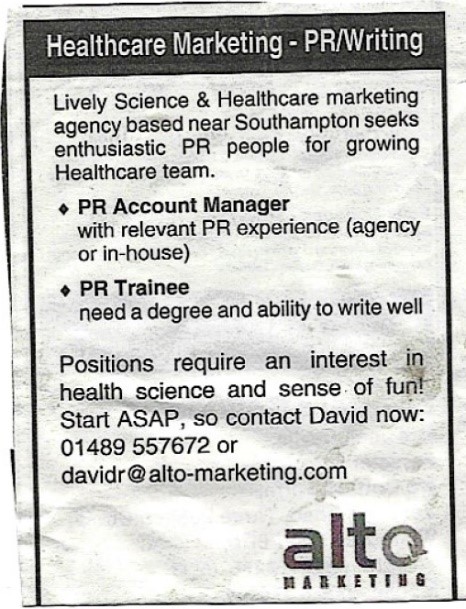
A BIT OF HISTORY. Like everything else, recruitment advertising has moved almost exclusively online, but here’s one of Alto Marketing’s first recruitment ads from around 2004, placed in the print edition of the Southampton Echo.
The development in SEO, SEM and social media marketing has increased the complexity of scientific marketing communications and resulted in a plethora of new job roles such as SEO Specialist, SEM Specialist, Social Media Manager, Content Strategist among others.
That concludes my look back at just some of the changes in scientific marketing over the last 20 years. Thanks for reading!
And if you need support in SEO, SEM or media planning from the people who understand scientific marketing, please get in contact.
References
[1] https://www.statista.com/statistics/216573/worldwide-market-share-of-search-engines/
[2] https://blog.hubspot.com/website/web-traffic-analytics-report
[3] https://online.maryville.edu/blog/evolution-social-media/#history
[4] https://www.ecomone.com/news/how-ppc-has-evolved-through-the-years