
Nematodes: Worming their Way into Research
25th November 2022 - Last modified 18th October 2023
20 years of Alto. 20 years of science. #15
By Ashley Hayes, Science Writer/Account Executive

As part of Alto Marketing’s 20 year celebrations, we’re looking back at some of the most important advances in science over this time in our blog series “20 years of Alto. 20 years of science.” In this blog, the spotlight has been placed on the research interests of Ashley Hayes, Science Writer/Account Executive at Alto. Here, she introduces an animal she studied as part of her PhD, the nematode, which is one of the largest, yet most underrated, group of animals on Earth. Read below to learn mind-blowing facts about nematodes, and discover how a single nematode species has shaped research over the past 20 years, particularly within the field of medicine.
Why Nematodes?
Firstly you might ask, what are nematodes? This group of multicellular organisms – often referred to as roundworms – displays an impressive amount of diversity. Nematodes drastically vary in size and appearance, although most are invisible to the naked eye. These worms can be found on almost every habitat on Earth and have a large, often negative, impact on the world in terms of human health and agriculture as they have the ability to infect humans, animals and plants.
During my PhD research, I studied soil-dwelling nematodes which parasitise plants. Although these worms are microscopic, they cause devastating effects on crop yields around the world (think potatoes, tomato, carrot, soybean – and just about every other economically important crop!). My research aimed to unravel the complex cellular mechanisms that nematodes deploy to feed on their hosts, which was pretty incredible stuff.
However, during my PhD, my eyes were opened to this group of organisms as a whole. Within the space of four years, I realised that nematodes might just be the most underrated animal phylum on Earth.
The Earth’s Weirdest and Most Wonderful Creatures
A fact most people might not realise is that nematodes are the most abundant animal on this planet. It is estimated that 400 quintillion worms currently exist – that’s 57 billion nematodes for every person on Earth! [1]
Unbelievably, nematodes inhabit the world’s most extreme environments, including the abyssal plain of the deep ocean floor [2], the Darwin mountains of Antarctica [3], and highly acidic hot springs in Japan [4].
Although most nematodes are microscopic – measuring less than 1 mm in length – the largest nematode recorded, Placentonema gigantissima, is reported to reach a whopping 8.4 metres long [5], showcasing the diversity of this phylum.
Nematodes also have a range of feeding strategies. This includes parasitic nematodes, which infect either humans, animals or plants, as well as free-living nematodes that feed on microorganisms and organic debris in the soil and water.
Nematodes are a fascinating yet overlooked group of animals, which have paved the way for several scientific discoveries over the past 20 years.
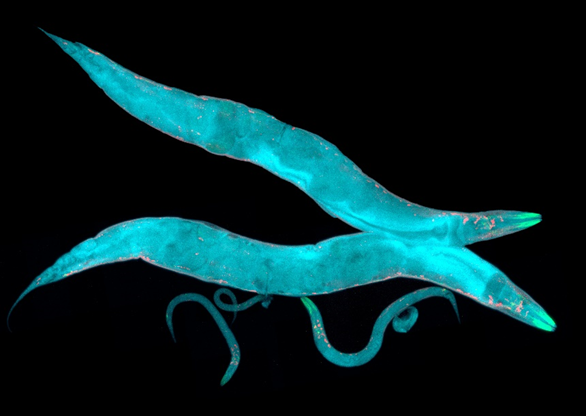
So how is this possible? Let’s look at how a single nematode species has impacted research in human disease, physiology and medicine. This species is the humble Caenorhabditis elegans, a microscopic nematode that is likely to be found in your garden.
Caenorhabditis elegans: An Out of This World Model Organism
C. elegans is arguably the best understood animal there is. This species was established as a model organism in the mid-1960s, and later was the first animal to have its genome sequenced in 1998 [6]. This worm was chosen as a model organism to study humans for many reasons, such as the fact that it has a fast life cycle and is easy to culture in the lab.
However, what could a tiny, hermaphroditic worm that feeds on bacteria possibly tell us about human traits? Amazingly, the genomes of humans and C. elegans are quite similar, with over 80% of C. elegans protein-encoding genes bearing resemblance to human genes [7].
Consequently, the use of C. elegans as a human model organism has helped to uncover some “out of this world” findings relating to human health and physiology.
Tiny Space Travellers
One astronomical use of C. elegans has been to study the repercussions of space travel on human health.
We know that space travel is extremely hard on the human body, due to microgravity and increased UV radiation. Prolonged space travel has been associated with reduced neuromuscular coordination, muscle mass, bone density and immune functioning [8].
To gain a better understanding of these physiological effects at a cellular level, C. elegans has been used as a model organism. This worm was first sent into space in 2004, as part of the European Space Agency’s Delta Mission, involving collaboration between the US, France, Canada and Japan.
With the results published in 2009, this space mission gave more insight into the genes that are responsible for some of the physiological changes observed during space travel. Additionally, C. elegans was shown to recover from the effects of radiation in space, a promising observation for human health! [9]
Since then, C. elegans has taken part in many other space missions. For example, the ‘Molecular Muscle Experiment’ saw thousands of worms sent to the International Space Station in 2018 to further investigate the effects of space travel on our physiology at a molecular level, particularly muscle decline. The Molecular Muscle Experiment has now reached its second phase, with scientists already uncovering how dopamine signalling can be altered in C. elegans during space travel to avoid muscle deterioration [10].
In time, these experiments hope to identify novel drugs to prevent the space-travel induced decline in muscle tissue. If successful, these drugs could the improve the health of astronauts, which in turn could allow us to travel further than man has ever gone before.
To Infinity and Beyond – What can C. elegans do for Medicine?
A more down to Earth use of C. elegans over the past two decades has been to improve knowledge of human diseases and the drug development process.
It is mind-boggling how a microscopic worm could tell us so much about human ailments! But many disease-causing genes have functional counterparts in C. elegans, and as a result, targeted genetic modification of C. elegans has provided insight into the genetic basis of several diseases. This includes autism [11], and neurodegenerative diseases such as Alzheimer’s disease, Parkinson’s disease and Amyotrophic Lateral Sclerosis [12].
C. elegans has also been used in drug discovery and development, enabled by advances in drug screening technologies over the past decade. Not only are pharmaceutical screens using nematodes high-throughput and inexpensive, they bridge the gap between cell-based assays and animal models, which helps reduce the number of drugs failing at the animal testing stage.
C. elegans is proving to be particularly useful in the hunt for treatments for Parkinson’s disease. This species can be genetically mutated to induce Parkinson’s and display defective dopamine neurons, which are a hallmark of the disease.
Worms with the Parkinson’s mutation demonstrate altered behaviour, with their bodies coiling in on themselves rather than moving in an ‘S’ shape. In a recent study, artificial intelligence has been developed to analyse the movement patterns of C. elegans, allowing for a large library of drugs to be tested on the genetic mutants, identifying pharmaceuticals that correct defective movement patterns.
From this, the five most promising Parkinson’s drugs were taken forward to animal models. This work identified the drug rifabutin, which has progressed to the clinical trial stage for the treatment of Parkinson’s induced motor dysfunction [13]. Over the next few years, hopefully C. elegans will be used as a high throughout drug discovery tool for the treatment of other prevalent diseases.
This is a Worm’s World
C. elegans is just one species within the weird and wonderful nematode animal phylum. With the potential to expand the human limits of space travel and identify cures for disease, who knows what else this worm could be used to discover.
About me
I have a keen interest in life sciences, which I can (almost truthfully) say started at birth. I’m a twin, and I’ve always been fascinated to understand how we have such different personalities considering we are genetically identical. Since newborns we have taken part in the Twins Early Development Study (TEDS), which is one of the largest global twin studies based at Kings College, London. From this early exposure to genetics research, my fascination on the molecular basis of life grew.
My degree was in general biology, where I found a love for the environment and sustainability and became especially interested in researching how we will be able to feed ourselves in the face of climate change and population growth. I realised that I could combine this newfound passion with my love for molecular biology. This led me to pursue a master’s degree and later on a PhD, studying the genetic basis of how crops are impacted by plant pests – including nematodes!
References
(1) Platt, H. M., Lorenzen S., editor. The phylogenetic systematics of free-living nematodes. London: The Ray Society; 1994. Foreward.
(2) Sebastian, S. et al. Comparison of the nematode fauna from the Weddell Sea Abyssal Plain with two North Atlantic abyssal sites. Deep Sea Research Part II: Topical Studies in Oceanography. 2007 Aug 1;54(16-17):1727-36.
(3) Zawierucha, K. et al. A nematode in the mist: Scottnema lindsayae is the only soil metazoan in remote Antarctic deserts, at greater densities with altitude. Polar Research. 2019.
(4) Suzuki, A.C. et al. Meiofaunal richness in highly acidic hot springs in Unzen-Amakusa National Park, Japan, including the first rediscovery attempt for Mesotardigrada. Zoological science. 2017;34(1):11-7.
(5) Nielsen, C. Sequences lead to tree of worms. Nature. 1998;392(6671):25.
(6) The C. elegans Sequencing Consortium. “Genome sequence of the nematode C. elegans: a platform for investigating biology.” Science. 1998; 2012-2018.
(7) Lai, C.H. et al. Identification of novel human genes evolutionarily conserved in Caenorhabditis elegans by comparative proteomics. Genome research. 2000;10(5):703-13.
(8) Williams, D. et al. Acclimation during space flight: effects on human physiology. Cmaj. 2009;180(13):1317-23.
(9) Adenle, A.A. et al. Review of the results from the International C. elegans first experiment (ICE-FIRST). Advances in Space Research. 2009;44(2):210-6.
(10) Sudevan, S. et al.Loss of physical contact in space alters the dopamine system in C. elegans. Iscience. 2022;25(2):103762.
(11) Rawsthorne, H. et al. Investigating autism associated genes in C. elegans reveals candidates with a role in social behaviour. PloS one. 2021;16(5):e0243121.
(12) Liang, J.J. et al. The contribution of C. elegans neurogenetics to understanding neurodegenerative diseases. Journal of Neurogenetics. 2020;34(3-4):527-48.
(13) Chen, K.S. et al. Small molecule inhibitors of α-synuclein oligomers identified by targeting early dopamine-mediated motor impairment in C. elegans. Molecular neurodegeneration. 2021;16(1):1-25.