
Making (Gravitational) Waves: Understanding the gravity of LIGO’s discovery
13th July 2022 - Last modified 19th October 2023
20 years of Alto. 20 years of science. #9
By Olivia Hillson, Science Writer
As part of Alto Marketing’s 20 year celebrations, we’re looking back at some of the most important advances in science over this time in our blog series “20 years of Alto. 20 years of science.” Here, Olivia Hillson mixes history and physics with a look back at the ancestry of gravity and then explores how our understanding of this fundamental force evolved with the detection of gravitational waves in 2015.
Think of a famous scientist…
… it’s probably Albert Einstein.
Einstein is, arguably, the most famous and widely known scientist in the world. In the UK you would be unlikely to find a single person who hasn’t heard the name. And it’s not just his name – his face finds its way onto everything from coffee mugs to internet memes. While a good number of people might be able to quote his famed equation (E=mc2), most wouldn’t be able to explain why he came to be so inescapably famous.
The answer is, essentially, that he was right. About a lot of things.
Things we are still proving correct to this day. Like Galileo and Newton before him, Einstein had an ability to see through to the heart of physics in a way unmatched by any of his contemporaries. A way that would stand the test of time for over a century.
The apple doesn’t fall far from the tree: the ancestry of gravity
In 1604 Galileo Galilei (usually referred to as simply Galileo) laid the foundation for the theory of gravity. Using mathematical equations to describe how objects in freefall behave on earth, he was unknowingly giving humans their first ever glimpse at the physics of gravity. [1]
Of course, Galileo is not usually remembered as the father of gravity. That title belongs to Sir Isaac Newton; a scientist working a lifetime later.
While it is extremely unlikely that the legendary apple actually fell onto his head causing an epiphany, Newton is still responsible for the entire foundation of our understanding of spacetime. His law of universal gravitation, published in 1687 [2], stated that every particle attracts every other particle with a force directly proportional to their mass, and inversely proportional to the squared distance between their centres. [3]
This was a mathematical representation of what was possible for scientists to observe at the time: gravity was a bigger force for bigger objects, and it got stronger the closer you were to the object’s centre. Newton had been able to unify what scientists knew about gravity on earth and the behaviours astronomers had observed in space. For a long time this was as far as anyone got with this work.
So now we return to Einstein.
It’s all relative: how special and general relativity revolutionised our understanding
Perhaps Einstein’s most famous discovery was relativity. And from that was born the idea of spacetime. Nowadays, the term has permeated so far through from the scientific community that we regularly see it used in pop culture and science fiction. But prior to Einstein’s theories, space and time were treated as completely separate entities.
Then, in 1905, the ‘Theory of Special Relativity’ was underpinned by a new idea: that three-dimensional space was actually part of a four-dimensional manifold with the addition of the one dimension of time. Spacetime. Einstein didn’t stop there though, ten years later in 1915 he went on to show that mass and energy curve spacetime in his Theory of General Relativity. [4]
It is this curvature of the spacetime field which gives us the force of gravity.
Imagine a tablecloth, stretched, and pulled tight so that it is flat. If you were to drop a tennis ball onto it, the cloth would dip, curving around the ball. If you were to then drop a marble onto it, the smaller marble would first create its own dip but then roll towards the tennis ball, caught in its larger dip – or gravity. Imagine then, that you were to drop something larger like a football. This would create a much larger curve in the cloth which would pull both the tennis ball and the marble towards it.
An object with mass, such as a planet like earth, curves spacetime around it in the same way that the tablecloth curves around the tennis ball – creating a gravitational pull. Objects with less mass, such as the moon, have a smaller effect on spacetime and so creates a smaller force of gravity – like the smaller force of gravity experienced by the astronauts during the moon landing.
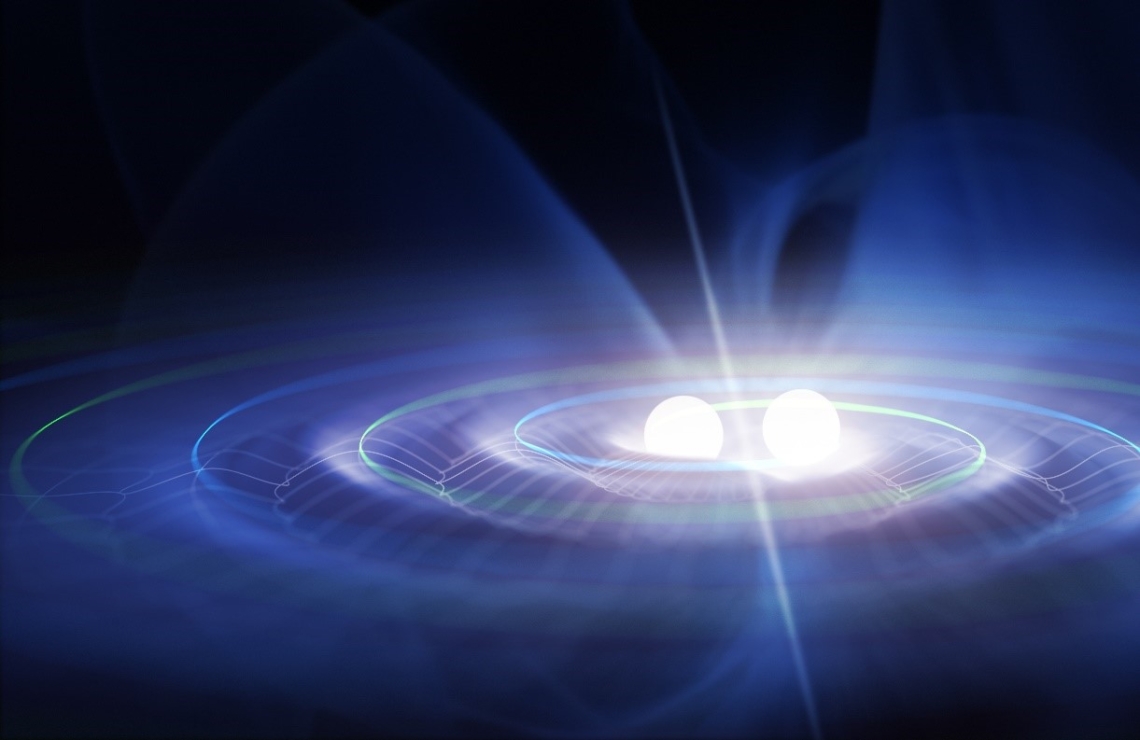
Much like the marble to the tennis ball, the moon is caught in the Earth’s larger gravitational pull, creating its orbit. Though the idea had been theorised before this by Oliver Heaviside and later Henri Poincaré, Einstein predicted that an object with mass moving at increasing speeds through spacetime would create ripples in its wake like a boat on water. Gravitational waves. [5]
Interferometers: the key to unlocking proof of gravitational waves
Gravitational waves remained theoretical for another century until 2015 when scientists at The Laser Interferometer Gravitational-Wave Observatory (LIGO) switched on their new and improved detectors. Within just 2 days, the first gravitational waves were detected and within a few months the announcement was made [6] – Einstein was right.
These first observed waves were generated by the collision of two black holes, 1.3 billion lightyears from earth. LIGO’s sensors don’t reach 1.3 billion lightyears, instead they detect the waves once they have moved through space and reached us. The gravitational waves caused by the black hole collision would be enormous and destructive, but by the time they reach earth they are extremely small and hard to detect. In this case, the LIGO sensors had to detect a wave which was 1,000 times smaller than the width of a singular proton. [7]
LIGO’s work is based on interferometers, a tool developed in the 1800s and used for a range of applications in science and engineering. The interferometers at LIGO work by splitting a single laser beam into two perpendicular directions and then returning them back to be detected. Since both arms of the interferometers are the same length, the beams should be returned at exactly the same time. However, since gravitational waves literally warp space, as the wave moves past the interferometer the length of the arms will change; one first then the other depending on the direction of the wave. This change in length means that the laser beams will be returned at fractionally different times. [8]
The big challenge here was to create an interferometer that could measure such a tiny change. So, while LIGO’s interferometers are, at their core, the same as those developed in the 1880s, they are far more sensitive than anything imagined by scientists of that time. Interferometers can be made more sensitive by having longer arms and a more powerful laser, however, there is a practical limit to what can be built experimentally. To detect gravitational waves, it was estimated that 1,200 km long arms and a 750 kW laser would be needed – practically impossible specifications. [9]
The scientists at LIGO cleverly used mirrors to solve both these issues. The LIGO interferometers have 4 km long arms, but inside the arm mirrors are used to bounce the laser beam back and forth more than 300 times. Thus, before it returns for detection it effectively travels the necessary 1,200 km. [9]
Similarly, while the initial laser that enters LIGO’s interferometers is only 40 Watts, a power recycling mirror is used to bounce the laser back into the interferometer, accumulating the power until it is high enough to detect a gravitational wave. [9]
Making waves: the controversy surrounding the discovery
Even with cutting edge interferometers, the signal from a gravitational wave once it reaches earth is astoundingly small and hard to detect. This issue is compounded by high levels of interference or noise in the readouts from the instruments. To tackle these issues, LIGO’s work was carried out with two interferometers, one in Washington state and one in Louisiana. Since gravitational waves travel at the speed of light it was possible to calculate the time difference between the two instruments getting the reading, allowing scientists to identify the gravitational wave above random noise. But this separation of real signal from noise caused dissent among scientists. [6]
In 2016, a team of physicists from Denmark even published a paper questioning LIGO’s original discovery. They suggested that, based on plots in their published paper, their analysis didn’t correctly account for noise. LIGO have stated that the plots the Danish team question were more for “illustrative” purposes to visually aid the paper. [6] Naturally, this doesn’t go very far to inspire trust.
Because gravitational wave events are unrepeatable, they can’t be independently checked. Consequently, we must place an enormous amount of trust in LIGO, their detection, and their analyses. [6]
Despite the questions about the transparency of LIGO’s analysis and certain events, the news of the discovery took the world by storm, filtering out far past the scientific community with headlines seen all over major news outlets and around the globe. So, it was no surprise that a Nobel Prize swiftly followed in 2017 for three key players in the development and ultimate success of LIGO. One half of the prize was awarded jointly to Caltech’s Barry C. Barish and Kip S. Thorne and the other half was awarded to MIT’s Rainer Weiss.
The widespread consensus is that LIGO have now successfully detected gravitational waves on a number of occasions (90 detections [10]) and in 2017 another interferometer joined the search for gravitational waves. Located in Italy, Virgo allows for even more confident identification of events by triangulating the signal received by all three interferometers spread around the globe. [6]
Death spiral: gravitational wave detection continues to push forwards
The ability to detect gravitational waves provides the opportunity to try to detect the fallout from a number of predicted celestial events. In January 2020, LIGO and Virgo detected two events of gravitational waves. These waves were caused by the final orbits of a neutron star around a black hole and the resulting collision – the first time this type of system had been observed.
When gravitational waves are detected, it is possible to also detect the event using a deep space telescope. In 2017, LIGO and Virgo detected the collision of two neutron stars and an accompanying light signal was also observed. However, this didn’t occur with the neutron star and black hole collision leading scientists to believe that the neutron star may have been ‘swallowed whole’. [11]
Discoveries such as this allow us to learn about how black holes and neutron stars behave in a way that was never possible before. In the future, it is hoped that this dual approach between LIGO and Virgo and deep space telescopes can help scientists to observe a black hole destroying a neutron star in more detail, to help improve our understanding of both entities. [11]
Scientists like Einstein and Newton could never have imagined such technology! And with tools like this at our disposal, it is exciting to imagine what discoveries about the universe wait for us just around the bend.
References
1. Charles Coulston Gillispie, The edge of objectivity; an essay in the history of scientific ideas. 1960: Princeton, N.J., Princeton Univ. Press.
2. Wikipedia. Philosophiæ Naturalis Principia Mathematica. Available from: https://en.wikipedia.org/wiki/Philosophi%C3%A6_Naturalis_Principia_Mathematica.
3. Wikipedia. Newton’s law of universal gravitation. Available from: https://en.wikipedia.org/wiki/Newton%27s_law_of_universal_gravitation.
4. Wikipedia. Spacetime. Available from: https://en.wikipedia.org/wiki/Spacetime.
5. Wikipedia. Gravitational wave. Available from: https://en.wikipedia.org/wiki/Gravitational_wave.
6. Michael Brooks, Exclusive: Grave doubts over LIGO’s discovery of gravitational waves, in NewScientist. 2018.
7. LIGO Caltech. What are Gravitational Waves? . Available from: https://www.ligo.caltech.edu/page/what-are-gw.
8. LIGO Caltech. What is an Interferometer? . Available from: https://www.ligo.caltech.edu/page/what-is-interferometer.
9. LIGO Caltech. LIGO’s Interferometer Available from: https://www.ligo.caltech.edu/page/ligos-ifo.
10. LIGO Scientific Collaboration. News. 2022; Available from: https://www.ligo.org/news/index.php#GWTC3-TGRwebinar.
11. UKRI. New source of gravitational waves discovered. 2021; Available from: https://www.ukri.org/news/new-source-of-gravitational-waves-discovered/.