
A World at the Extremes: Extremophilic Micro-organisms
20th May 2022 - Last modified 19th October 2023
20 years of Alto. 20 years of science. #5
By Rose Layton PhD, Science writer

As part of Alto Marketing’s 20 year celebrations, we’re looking back at some of the most important advances in science over this time in our blog series “20 years of Alto. 20 years of science.” We gave each of the scientists in the Alto team the chance to write about an area they love or that they’ve worked on during their research careers. Here, Rose Layton, Science Writer, takes us on a journey from the heart of Chernobyl to the arctic circle to tell us more about microbes that survive in the harshest conditions – and what we can learn from them.
Hiding in plain sight is a whole universe of life that most of us barely think about. This invisible world surrounds us, it covers us, and it infiltrates us. And, while it mostly lurks in the secret shadows of our planet, it is vast beyond comprehension and absolutely fundamental to life as we know it.
I am, of course, talking about the microbial world.
Like most people, I only really thought about microbes when they made me sick. But, during my undergraduate years, microbes escaped from the shadows and entered the forefront of my mind. Why? From coral reefs and tropical forests to wastewater treatment plants and even our own guts, they shape so many facets of our existence. And isn’t that amazing?
I was particularly fascinated with the extreme kind of microbes – those that live in environments we think of as inhospitable. By weaponizing an arsenal of interesting and sometimes bizarre adaptations, microbes have exceptional potential to thrive in some unimaginable places. Over the past 20 years, novel technology has allowed us to uncover these adaptations, letting us peer into the life of the most radical organisms of our planet. Let’s take a look at some examples of how our understanding of this extreme, invisible, and astonishing world has grown over the past few decades.
Radiation munching microbes
Since the tragic events of Chernobyl in 1986 left a 2,600 km² area inhabitable to humans for the next 24,000 years, wildlife has surprisingly flourished – with lynx, bison, deer and other animals roaming through the dense forests. If we venture further into the heart of Chernobyl, as far as the highly radioactive reactor itself, perhaps you’ll be surprised to hear that life is flourishing here too?
Cryptococcus neoformans, a well-known fungus, was found to be setting up home in the Chernobyl bioreactor in 1991. And if this wasn’t enough, the fungus actually grows towards the hottest and most radioactive areas.
This is because C. neoformans eats radiation for breakfast, lunch, and dinner. Dadachova et al. (2007)[1] were the first to demonstrate that radiation was on the menu, observing that C. neoformans exposed to ionizing radiation grew significantly faster compared to unexposed cells.
The research group also harnessed a technique known as electron spin resonance spectroscopy (ESR) to show that melanin, a natural human skin pigment, was responsible for C. neoforman’s strange diet. Radiation exposure induced a shape change in the fungal melanin molecule resulting in its increased ability to transfer electrons – a critical process for energy production. In this way, melanin is hypothesised to function similarly to how chlorophyll help plants convert light energy into chemical energy during photosynthesis. Perhaps even more bizarrely, melanin pigmented fungi are known to take up residence inside spacecrafts in low Earth orbit, where exposure to ionizing radiation is also heightened. Together, these findings have led scientists to speculate about whether organisms like C. neoformans could be used to make a space sunscreen – a self-replenishing radiation shield for deep space exploration[2]!
To the next extreme
If you ever take a microbiology class on extreme microorganisms (extremophiles), there’s a high chance that you’ll get to know a species called Deinococcus radiodurans.
D. radiodurans has been repeatedly referred to as the ‘world’s toughest bacteria’ – surviving extreme cold, acid, dehydration, radiation and even a vacuum. Interestingly, it turns out that its ability to cope with high doses of radiation is a by-product of its capacity to resist desiccation. In fact, this is often how microbes become polyextremophiles (i.e., an organism who can tolerate multiple extreme environmental factors).
The dangerous lifestyle of D. radiodurans has attracted a lot of attention over the past decade. In particular, its DNA repair machinery has been the focus of many genetic, biochemical and structural studies, which have progressed alongside advances in technology. This is because the key to D. radiodurans impressive range of tolerance is not necessarily about remaining unscathed – but is more to do with its ability to clean up the mess made.
When a cell is exposed to high levels of radiation or desiccation, its DNA shatters into fragments. Most organisms can’t put the puzzle back together and ultimately meet their demise. But with four copies of its genome to be used as blueprints and some exceptional DNA repair abilities, D. radiodurans can reassemble the genome puzzle with great accuracy after hundreds of DNA breaks[3].
While there was much excitement about what novel DNA repair machinery might be encoded in the genome of D. radiodurans, initial genome analysis revealed a pretty typical set of repair protein genes[4]. In fact, most of the DNA repair proteins identified are also found encoded in many other bacteria. Moreover, D. radiodurans is actually missing several key DNA repair proteins[4]!
The secret to its exceptional DNA repair talents appears to be the result of small but accumulative changes. Interestingly, in some cases, D. radiodurans proteins are encoded by DNA sequences that are strikingly similar to those found in the genomes of non-radiation resistant organisms[4].
More recently, it has become apparent that protecting the DNA repair proteins is key to D. radiodurans survival at high exposure to radiation. Rather than fixing them once they’ve broken, D. radiodurans actively keeps proteins safe from reactive oxygen species (ROS) generated by radiation with particularly high concentrations of manganese[5].
Some like it cold
If I tell you to think about life in the Arctic, you’ll likely conjure up images of polar bears, reindeers, and maybe even Arctic foxes. But if we drop below their feet and into the sea ice, there is another world – and this one is teeming with life.
As ice crystals form from seawater, they exclude salt. The salt gets pushed out into the surrounding liquid water, increasingly lowering its freezing temperature. Consequently, sea ice isn’t just a big block of ice. It’s a big block of ice that’s permeated with extremely salty liquid waterways – known as brine channels. And in these hypersaline and extremely cold (sub-zero) brine channels are a tonne of microbes.
More accurately, sea ice can have as many as 100,000,000 cells/mL[6]. That’s about as many as a balmy, temperate gram of soil. There’s plenty of different microbial species that choose this cold and salty existence but the award for ‘most psychrophilic*’ bacteria goes to a microbe called Psychromonas ingrahamii (who has been observed growing exponentially at -12°C with 240 hours generation time – and is likely to grow at colder temperatures)[7].
Not only are these sea ice microorganisms growing but they’re moving too. Colwellia psychrerythraea, for example, is still able to swim around at temperatures down to -15 °C[8]! As well as swimming, Colwellia, like many other sea ice microorganisms, manufactures its own coat. By secreting a substance known as extracellular polysaccharide (or EPS), Colwellia surrounds itself in a thick gel that keeps it warm and isolated from the highly saline environment[9].
The discovery of such extreme microbes helps support the idea of extra-terrestrial life. Given most planets and moons with the potential to harbour life have sub-zero surface temperatures and highly saline liquid content (e.g. Titan’s subsurface ocean), it should come as no surprise that scientists are turning to sea ice for clues about how life could exist in space[10].
Recently, one research group used proteomics to delve deeper into how Colwellia maintains activity during long-term exposure to extreme sub-zero temperatures and high salinities in sea ice[10]. The study highlighted the importance of carbon, nitrogen and fatty acid metabolism in exposure to cold, saline, and nutrient-limiting environments but most excitingly, identifies polypeptide biomarkers to aid astrobiological searches for life on other icy worlds.
From frost flowers to the future
Would you believe me if I told you that, on occasion, blossoming atop the sea ice and stretching as far as the eye can see, is a field of flowers? Under very specific conditions, delicate and intricate tree-like structures, known as frost flowers, are formed on the surface of young sea ice.
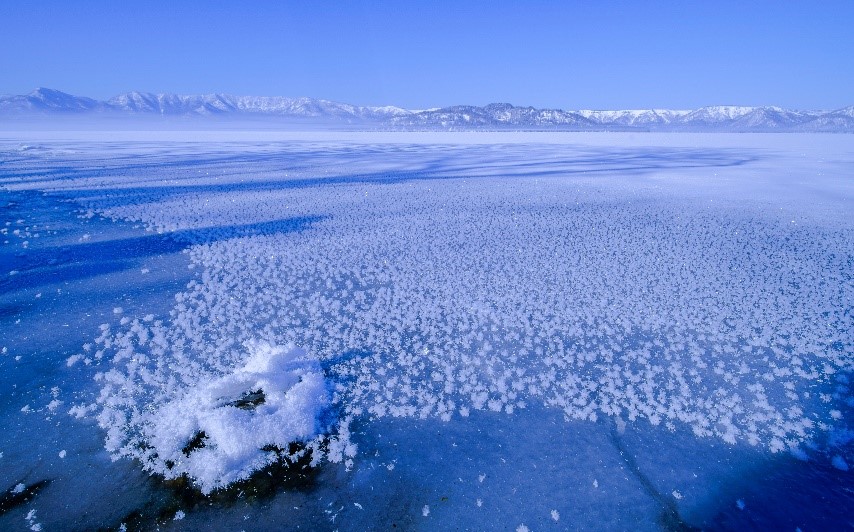
But don’t be fooled by their beauty – they’re even more cold and salty than the underlying sea ice. With such extreme temperatures and salinities, you wouldn’t think that life would choose to live here. Spoiler alert – it does.
Well, it might. During my PhD we decided to take a closer look at frost flowers. Using 16S rRNA sequencing – a technique that allows you to profile the species of bacteria in an environment – we found that frost flowers and the underlying sea ice looked very different in terms of their bacterial residents.
This suggests that there is some type of selection happening i.e., some prefer the slightly more tropical climes of the sea ice while other, hardcore, species take a hike to the frost flower environment.
Metagenomic sequencing allows scientists to take a look at what bacteria can do (i.e, their functions) not just who’s there. In my PhD research, we used this approach to see if we could understand why there was this difference in bacterial community structure. But you’ll have to wait for the paper to find out more…!
What’s cool (excuse the pun), is that life actually exists here – and technology has advanced to such a degree that we have the means to gain so much insight into who, how, and why. It’s exciting to consider what technological advancements the next 20 years will bring, and who we might discover in the most extreme parts of our world – or beyond!
About Me:
Growing up, I was taught to question everything. I had an innate curiosity in the natural world. And, I had a borderline crazy fascination with bugs and beetles. Naturally, this led me into a research career. But my interests got smaller than insects and I delved into the world of microbes! I think they’re fascinating – from the amazing ways we can manipulate them into producing products such as pharmaceuticals to their ability to colonise, live, and even thrive in the most extreme conditions. My research career has been diverse but my PhD primarily looked at the microbes that live in extreme Arctic habitats – specifically, the atmosphere, snow, sea ice, and frost flowers. I was (and still am!) interested in who was there, why, what they were doing – and how dramatically this would be affected by a rapidly warming Arctic. We often think about the loss of big animal species to climate change but the loss of microbes could be equally, if not more, important.
*psychrophilic microbes are those that love the cold! More technically, they have an optimal temperature for growth at about 15°C or lower, a maximal temperature for growth at about 20°C and a minimal temperature for growth at 0°C or lower.
References
1. E. Dadachova et al., “Ionizing Radiation Changes the Electronic Properties of Melanin and Enhances the Growth of Melanized Fungi,” PLoS One, vol. 2, no. 5, p. e457, May 2007, doi: 10.1371/JOURNAL.PONE.0000457.
2. G. K. Shunk, X. R. Gomez, C. Kern, and N. J. H. Averesch, “A Self-Replicating Radiation-Shield for Human Deep-Space Exploration: Radiotrophic Fungi can Attenuate Ionizing Radiation aboard the International Space Station,” bioRxiv, p. 2020.07.16.205534, Nov. 2021, doi: 10.1101/2020.07.16.205534.
3. M. M. Cox, J. L. Keck, and J. R. Battista, “Rising from the Ashes: DNA Repair in Deinococcus radiodurans,” PLOS Genet., vol. 6, no. 1, p. e1000815, Jan. 2010, doi: 10.1371/JOURNAL.PGEN.1000815.
4. J. Timmins and E. Moe, “A Decade of Biochemical and Structural Studies of the DNA Repair Machinery of Deinococcus radiodurans: Major Findings, Functional and Mechanistic Insight and Challenges,” Comput. Struct. Biotechnol. J., vol. 14, pp. 168–176, Jan. 2016, doi: 10.1016/J.CSBJ.2016.04.001.
5. M. J. Daly et al., “Protein Oxidation Implicated as the Primary Determinant of Bacterial Radioresistance,” PLOS Biol., vol. 5, no. 4, p. e92, Apr. 2007, doi: 10.1371/JOURNAL.PBIO.0050092.
6. A. Boetius, A. M. Anesio, J. W. Deming, J. A. Mikucki, and J. Z. Rapp, “Microbial ecology of the cryosphere: sea ice and glacial habitats,” Nat. Rev. Microbiol. 2015 1311, vol. 13, no. 11, pp. 677–690, Sep. 2015, doi: 10.1038/nrmicro3522.
7. J. Breezee, N. Cady, and J. T. Staley, “Subfreezing growth of the sea ice bacterium ‘Psychromonas ingrahamii,’” Microb. Ecol., vol. 47, no. 3, pp. 300–304, 2004, doi: 10.1007/S00248-003-1040-9.
8. K. Junge, H. Eicken, and J. W. Deming, “Motility of Colwellia psychrerythraea strain 34H at subzero temperatures,” Appl. Environ. Microbiol., vol. 69, no. 7, pp. 4282–4284, Jul. 2003, doi: 10.1128/AEM.69.7.4282-4284.2003/ASSET/F32FD469-0AA0-45FA-AEF1-F3952430E776/ASSETS/GRAPHIC/AM0732081001.JPEG.
9. J. G. Marx, S. D. Carpenter, and J. W. Deming, “Production of cryoprotectant extracellular polysaccharide substances (EPS) by the marine psychrophilic bacterium Colwellia psychrerythraea strain 34H under extreme conditions,” Can. J. Microbiol., vol. 55, no. 1, pp. 63–72, Jan. 2009, doi: 10.1139/W08-130.
10. M. C. Mudge et al., “Subzero, saline incubations of Colwellia psychrerythraea reveal strategies and biomarkers for sustained life in extreme icy environments,” Environ. Microbiol., vol. 23, no. 7, p. 3840, Jul. 2021, doi: 10.1111/1462-2920.15485.